Material Selection Guide for Precision Castings — How to Choose between Steel Castings and Iron Castings for Stable Operation of Construction Machinery
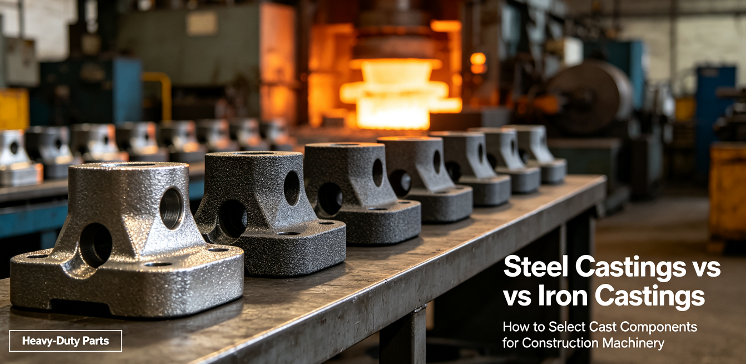
Recently, buyers and design engineers in the construction machinery, petroleum equipment and agricultural machinery sectors have paid close attention to material selection for cast components. During the development of heavy-duty equipment parts, the selection between steel castings and iron castings directly affects component service life, operational safety and overall project costs. Many customers tend to confuse their applicable scenarios at the design stage, leading to part failure and rework in later phases.Although steel castings and iron castings both belong to casting products, they differ greatly in metallographic structure and mechanical performance, and serve completely different working conditions.Steel castings cover carbon steel castings, low-alloy steel castings and alloy steel castings with steel-based microstructure. They deliver outstanding tensile strength, yield strength, elongation and impact toughness, offering strong resistance to impact and alternating loads. Meanwhile, steel castings feature good weldability. Under repeated impact, alternating tension and low-temperature working environments, steel castings are less prone to brittle fracture.However, they also have drawbacks. Molten steel has poorer fluidity than molten iron, making steel castings more likely to suffer from shrinkage porosity and cracks. Raw material and manufacturing costs are higher, and machining is relatively difficult. Therefore, steel castings are widely applied to construction machinery brackets, forklift clevis joints, petroleum downhole components, heavy-duty mining parts and marine connecting fittings, which bear long-term impact loads and require high safety reliability.Iron castings mainly include grey iron and ductile iron. Grey iron contains flaky graphite inside, featuring excellent vibration damping and noise reduction performance. Molten iron flows well and can easily form complex thin-wall housings with low casting shrinkage and lower production costs. It also boasts good machinability. Nevertheless, grey iron is brittle with low elongation. It tends to crack under tensile force and can barely be welded for repair. Typical applications include static-load components without severe shock, such as machine tool beds, ordinary pump bodies and box housings.Ductile iron features spherical graphite. Its performance sits between grey iron and steel castings. It achieves greatly improved strength and toughness compared with grey iron and offers high cost performance for medium-load components. Even so, its ultimate toughness under heavy impact and low-temperature conditions is still inferior to alloy steel castings.Industry technical experts have summarized selection criteria:
- Prioritize steel castings when components endure heavy impact, alternating vibration loads, or where fracture may cause serious safety hazards.
- Grey iron is suitable for static load applications requiring vibration damping, noise reduction and cost control.
- For medium-load scenarios balancing strength and budget, ductile iron can be evaluated.
In addition, steel castings are preferred for parts requiring on-site welding assembly or repair, or working in low-temperature environments. Grey iron will turn extremely brittle at low temperatures and is not recommended for low-temperature impact service. Precision investment cast steel can achieve high dimensional accuracy to reduce subsequent machining allowance and meet high-precision requirements for complex special-shaped components.Industry professionals mention that material selection for castings should not depend solely on purchase unit price. Engineers need to comprehensively evaluate load type, operating temperature, welding requirements and inspection standards as well as service life. Design and purchasing teams can provide component load parameters, drawings and working condition information. Foundries can recommend suitable material grades and casting processes to avoid equipment failures caused by improper material selection, cut later maintenance costs and guarantee long-term stable operation of equipment.