Understanding Shrinkage Cavity and Shrinkage Porosity: Key Defect Control in Investment Casting
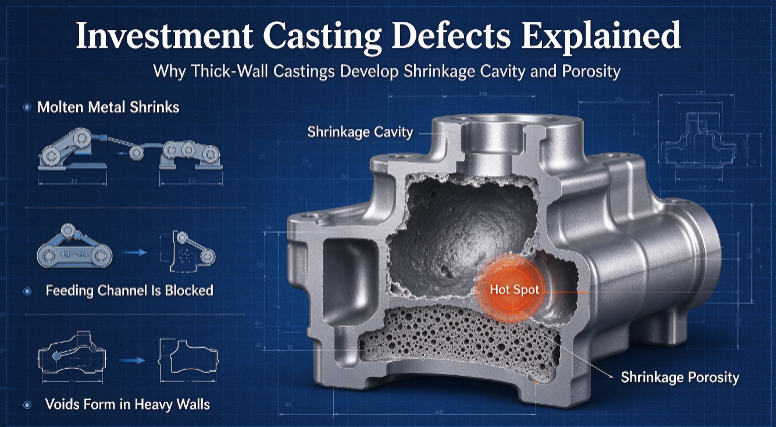
Investment casting delivers near-net-shape metal components with complex geometry for construction machinery, oil & gas, marine and automotive sectors. However, shrinkage-related defects remain one of the top challenges affecting casting density, pressure tightness and mechanical performance. Our engineering team releases an in-depth technical brief explaining the difference between shrinkage cavity and shrinkage porosity, why thick-wall sections are vulnerable, and proven process controls to reduce rejection rates.Shrinkage cavity and shrinkage porosity both originate from volumetric contraction when molten alloy changes from liquid phase to solid. As metal solidifies, volume shrinks naturally. If no sufficient liquid metal feeds the contracting zone, voids form inside the casting. Many buyers confuse shrinkage defects with gas porosity, but they have clear distinctions.A shrinkage cavity is a concentrated, large irregular void with rough inner walls and visible dendritic grain marks. It usually appears at the core of hot spots. This concentrated void severely weakens castings; pressure-containing parts may suffer direct leakage, and heavy-load components risk sudden fracture under service stress.Shrinkage porosity refers to clusters of tiny, dispersed, interconnected micro voids. These honeycomb micro-pores are often invisible on raw casting surfaces and only revealed after machining or X-ray inspection. Although there is no large single cavity, interconnected micro voids degrade density, reduce fatigue strength and cause oil or hydraulic leakage. Alloys with a wide solidification temperature range are more prone to shrinkage porosity, while alloys with narrow freezing ranges tend to form concentrated shrinkage cavities.The core reason thick-wall sections easily develop these shrinkage defects is the hot spot effect. Thin sections cool and solidify rapidly by releasing heat through the ceramic shell. Thick sections hold much more molten metal and store higher thermal energy, so they cool far slower and solidify last. When the thick hot spot begins to contract, surrounding thin regions have already turned solid, cutting off feeding channels. Liquid metal from risers or gating systems can no longer flow into the hot spot to compensate shrinkage, leaving voids inside the heavy wall.Multiple secondary factors worsen the problem. Abrupt wall-thickness transitions create local hot spots even if the overall wall is not extremely thick. Slow cooling in thick zones produces coarse grains, and narrow gaps between grains make liquid feeding harder. Besides, risers have limited effective feeding distance. Once the hot spot is beyond the feeding range, shrinkage defects will occur. The low thermal conductivity of investment casting ceramic shell also traps internal heat, so the outer layer solidifies first while the inner core remains liquid. Internal contraction creates voids when the outer solid shell cannot support itself.Our foundry adopts a full-set control strategy from DFMEA design review to final inspection:
- Design optimization: Keep uniform wall thickness, eliminate isolated heavy metal masses, apply smooth transitions and corner fillets to break hot spots. Add auxiliary process bosses for feeding channels where wall reduction cannot be achieved.
- Casting process engineering: Place properly sized risers at hot spots and install chills on thick sections to adjust cooling speed and realize directional solidification. The shrinkage voids will be transferred into risers and removed during post machining.
- Pouring parameter tuning: Control pouring temperature carefully. Excessively high temperature increases liquid shrinkage and amplifies shrinkage risk. Shell preheat temperature is matched to stabilize solidification sequence.
- Non-destructive inspection: X-ray radiography is applied for thick-wall critical castings to detect hidden shrinkage cavities and porosity. Many internal defects stay invisible before machining.
“Distinguishing shrinkage cavity, shrinkage porosity and gas porosity is the first step for quality improvement,” our chief metallurgist commented. “Gas porosity features smooth round holes caused by trapped gas. Shrinkage defects have rough dendritic surfaces, caused by insufficient feeding. Remedial methods are completely different. Root cause analysis must be carried out before adjusting production parameters.”For global buyers sourcing high-performance investment castings, early DFM review at the design stage is the most cost-effective way to avoid shrinkage defects. Our technical team provides free casting feasibility assessment, gating simulation and defect risk evaluation for custom OEM orders.