Industry News: Clear Differences Between 304 and 316L Stainless Steel Castings, Working Condition Matching Determines Long-Term Service Value
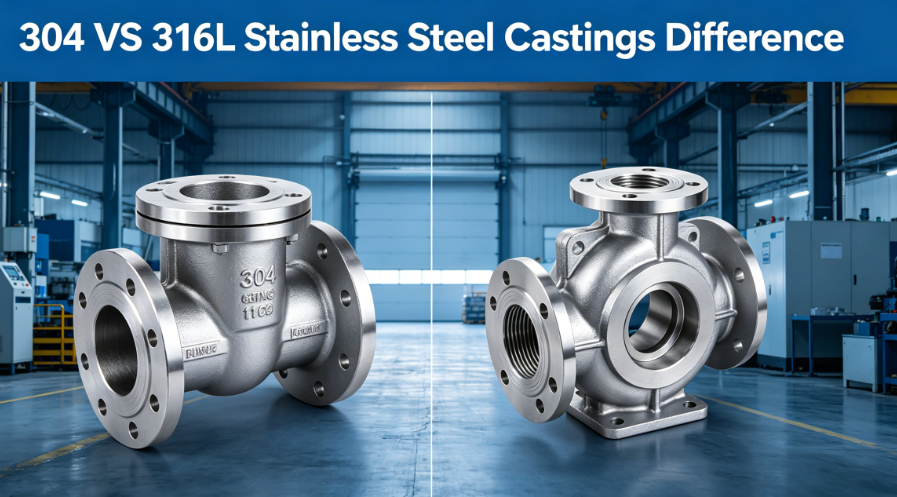
Recently, orders for stainless steel investment castings have kept rising driven by marine equipment, chemical pumps & valves, food pharmaceutical and construction machinery industries. Many purchasers encountered premature corrosion failures caused by improper material selection only focusing on low cost. Professional technical experts from precision casting factories sorted out the core disparities between 304 and 316L austenitic stainless steel castings to provide standardized reference for material selection across the whole industrial chain.
1. Chemical Composition: Root of Performance Gaps
304 stainless steel contains around 18% chromium and 8% nickel without molybdenum, with maximum carbon content of 0.08%.316L features 16%–18.5% chromium and 10%–14% nickel, plus approximately 2% molybdenum. The letter "L" stands for low carbon, controlled under 0.03%.Molybdenum is the key alloy element boosting resistance to pitting and crevice corrosion. Low-carbon composition effectively reduces intergranular chromium depletion and corrosion risks after welding or high-temperature forming.Both materials adopt mainstream silica sol investment casting technology. Nevertheless, 316L with higher precious metal content of nickel and molybdenum has a narrower melting temperature window. Thick-wall 316L castings are prone to component segregation, requiring stricter control on temperature, deoxidation and refining processes.
2. Corrosion Resistance Creates Application Boundaries
In dry indoor atmosphere, normal fresh water and non-corrosive environments, 304 and 316L show similar anti-rust performance. Their gaps become prominent once exposed to chloride ions, weak acid or alkali media.Chloride ions from seawater, coastal salt fog, salted food, swimming pool water and bleaching agents easily destroy the passive film of 304, resulting in rust spots and perforation within months. The passive layer of 316L is far more stable, with several times better chloride corrosion resistance. Over 95% of marine engineering and ship supporting castings adopt 316L.Welded structures highlight their difference greatly: 304 tends to form chromium-depleted zones near welds, which rust easily without solution annealing after welding. The low-carbon characteristic of 316L brings inherent welding anti-corrosion advantages, making it the top choice for heavily welded assembled equipment. 316L also lasts much longer against weak acid, phosphoric acid, printing and dyeing chemical liquids.
3. Minor Differences in Mechanical, Heat & Machining Performance
At room temperature, tensile strength, yield strength and low-temperature toughness are nearly identical for both grades, with equivalent basic pressure-bearing and structural load capacity. Slight differences exist in heat resistance: 304 can stably work up to 800°C continuously, while 316L is recommended for long-term use below 700°C. 304 boasts slightly better high-temperature oxidation resistance, yet 316L performs superiorly against chemical corrosion under heat.Both are high-toughness austenitic steels prone to tool sticking during cutting, demanding low cutting speed and special cutters. 316L wears cutting tools slightly faster due to higher alloy ratios. They share identical surface treatment processes including pickling passivation, mechanical polishing and electrolytic polishing, presenting indistinguishable gloss visually. Salt spray tests prove 316L has far longer anti-corrosion endurance.
4. Cost & Full Lifecycle Cost-Performance
Raw material cost of 316L is 20%–40% higher than 304 owing to expensive molybdenum and nickel. Combined with stricter melting control and higher heat treatment loss, finished precision castings of the same specification cost 20%–30% more for 316L.Although 304 cuts upfront procurement cost, overall economy shall be evaluated comprehensively under harsh corrosive conditions. A chemical plant once used 304 pump housings for seawater service, which leaked and shut down production after only 8 months. Replaced with 316L castings, the equipment ran stably for more than 5 years. Despite extra material premium, maintenance, replacement and downtime expenses were greatly reduced.304 optimizes cost for dry, non-corrosive equipment; 316L delivers better long-term value for safety-critical, long-service anti-corrosion components.
5. Standardized Application Scenarios
Suitable for 304 Stainless Steel CastingsGeneral food machinery, tap water pipeline valves, standard indoor pump bodies, construction machinery parts for dry environments, household hardware, common structural components without corrosion, inland outdoor ordinary equipment.Suitable for 316L Stainless Steel CastingsMarine ships, offshore petroleum equipment, seawater desalination, anti-corrosion chemical pumps & valves, dairy and pickling processing equipment, medical precision components, coastal facilities with heavy salt fog, swimming pool water treatment, pressure-bearing anti-corrosion parts with extensive welding.
Expert Tips on Material Selection
Many buyers only compare unit price while ignoring medium working conditions. Losses from corrosion shutdown, rework and warranty compensation often exceed material price gaps. Qualified precision casting manufacturers can provide spectrum material reports, salt spray test certificates and heat treatment quality guarantees. Small sample salt spray verification is suggested before mass orders. For extremely corrosive working conditions, duplex stainless steel 2205 and 2507 perform better than 316L as high-end alternatives.With accelerating exports of high-end domestic equipment, overseas clients mostly specify 316L for coastal and chemical supporting castings. Refined material grading has become a major upgrading trend of the precision casting industry.