What causes porosity in investment castings and how to prevent it?
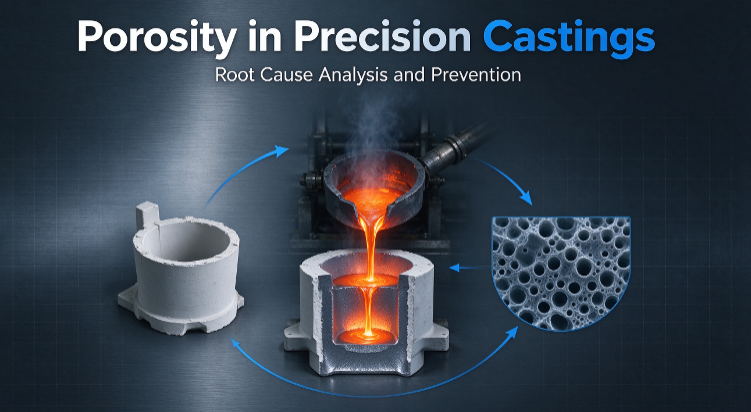
Porosity is one of the most common defects in silica sol investment castings. It appears as smooth, round or oval voids inside or on the surface of castings, which is different from irregular shrinkage porosity. Porosity will reduce mechanical strength and cause leakage on pressure-bearing components, greatly affecting service safety.There are four main types of porosity: entrapped gas porosity, mold shell gas porosity, precipitated gas porosity and reaction porosity.
- Entrapped gas porosity comes from turbulent filling during pouring. Poor gating design leads to fast and chaotic metal flow, trapping air inside the mold cavity before gas escapes.
- Mold shell gas porosity is widely seen in silica sol process. It is caused by insufficient dewaxing, incomplete drying of shell layers, low shell firing temperature or short holding time. Residual wax, carbon residue and moisture inside the shell will decompose into large amounts of steam and CO gas when contacting molten steel, forming pores.
- Precipitated porosity is generated from gas dissolved in molten metal. Rusted, oily or damp raw materials and returns introduce hydrogen and nitrogen into liquid steel. When the metal solidifies, gas solubility drops and tiny dispersed pores separate out, often found in heavy sections.
- Reaction porosity occurs through chemical reactions between molten metal and the shell surface. Improper refractory material selection triggers interfacial reactions and creates subsurface pinholes.
We take full-process measures to control porosity:
- Optimize gating and riser system. Adopt bottom or stepped pouring to stabilize metal flow. Add vents and risers at the highest positions of castings to release cavity gas smoothly.
- Strictly control shell making, dewaxing and firing. Each shell layer is fully dried under controlled temperature & humidity. Complete dewaxing and high-temperature firing remove residual wax, carbon and moisture to guarantee good shell permeability.
- Manage melting and refining. Clean raw materials and recycled scrap before melting. Add deoxidizers properly and apply argon degassing if required to reduce H, O, N content. We control pouring temperature within a suitable window to avoid extra gas absorption.
- Optimize casting geometry and inspection. We suggest uniform wall thickness and proper radii during design review. X-ray and PT penetrant testing are available to inspect internal and surface porosity for critical parts such as construction machinery, marine and oil & gas components.