Material Selection Determines Casting Quality | Investment Casting Supports a Full Range of Engineering Alloys for Custom Requirements
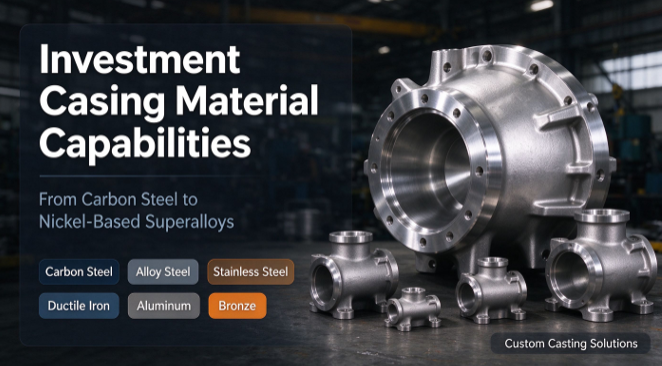
In the supply chains of construction machinery, forklifts, petroleum equipment, marine, agricultural machinery, hydraulic and automotive components, investment casting (lost wax casting) stands out as a preferred manufacturing process for global purchasing engineers. It is a near-net-shape forming technology capable of producing complex inner cavities and irregular geometries. A frequent question from overseas buyers at the early inquiry stage is: what materials can be cast via investment casting? How to select suitable alloys, and which materials match silica sol or water glass casting processes?As a professional investment casting manufacturer, we have a complete melting workshop covering carbon steel, alloy steel, various stainless steels, ductile iron, non-ferrous metals and nickel-based superalloys. We produce parts in compliance with GB, ASTM, DIN, EN and other international standards. Both silica sol and water glass processes are available, and our technical team will recommend the optimal solution based on working conditions, corrosion resistance, strength requirements, budget and lead time.Carbon steel is the most widely used material for structural castings and works well with both water glass and silica sol processes. Common grades include Q235, Q345, 16Mn, ZG230-450, WCB, WCC, GS235, 1020 and 1045. Carbon steel features good weldability and competitive cost. After normalizing heat treatment, it delivers stable toughness. It is widely used for brackets, yoke joints, bases, general valve housings and other load-bearing parts without strict anti-corrosion demands.Alloy steel contains added chromium, molybdenum, manganese and nickel. With proper heat treatment, it achieves higher tensile strength, wear resistance and hardenability for heavy-load, impact-prone and abrasive applications. Typical grades are 42CrMo, 40Cr, 4140, 4340 and 8620. These alloys are commonly specified for truck suspension parts, agricultural transmission components, mining equipment and hydraulic castings. Alloy steel requires strict control of deoxidation, pouring temperature and cooling sequence. High-spec orders usually adopt silica sol investment casting, combined with quenching & tempering or carburizing treatment to minimize defects such as porosity and shrinkage.Stainless steel is a popular choice for export, chemical, marine and oil & gas projects, mostly produced by the silica sol route. Austenitic grades such as 304 (CF8), 304L and 316L (CF8M) offer excellent resistance to acid and salt corrosion for seawater, chemical fluid and food machinery service. Martensitic grades 410 and 420 gain high hardness and wear resistance after quenching. 17-4PH precipitation hardening stainless steel balances high strength and moderate corrosion resistance for high-pressure hydraulic components. Duplex stainless steel 2205 and 2507 provides superior chloride corrosion resistance for harsh offshore and oilfield environments.Ductile iron grades QT400, QT450 and QT500 are also available for investment casting. It combines the toughness of steel with good vibration damping and wear resistance at a favourable cost. It is widely used for agricultural housings, pump bodies and counterweight castings. Water glass casting brings better cost performance for ductile iron parts.For non-ferrous alloys, A356-T6 aluminium alloy is lightweight with good thermal conductivity, ideal for lightweight hydraulic valve bodies and construction machinery brackets. Solution and ageing heat treatment is required to reach target mechanical properties. Bronze alloys including tin bronze, aluminium bronze and brass deliver outstanding wear and seawater corrosion resistance, often applied for bushings, worm gears and marine fittings. Non-ferrous metals have lower melting points and demand special shell-making and degassing procedures to reduce porosity risks.For high-temperature demanding applications, we supply nickel-based superalloys such as Inconel 625, Inconel 718 and HK40. These grades are almost exclusively produced by silica sol casting, and premium grades can be poured under vacuum. They feature high-temperature strength and creep resistance for furnace parts, gas system components and other high-value assemblies.Beyond material capability, investment casting can realize undercuts and internal flow passages which are difficult or impossible to machine directly. Dimensional tolerances range from CT4 to CT9, and surface roughness can be controlled accordingly. Our in-house service package covers heat treatment, CNC machining, shot blasting, passivation, hot-dip galvanizing, PT penetration testing, X-ray inspection and spectrometer material verification. We can provide material certificates, mechanical test reports and third-party inspection documents. We support export terms including EXW, FOB and CIF to serve OEM custom casting buyers from Europe and America.When selecting materials for your project, it is important to clarify drawing tolerances, wall thickness, heat treatment, surface finish and inspection standards together with alloy grade. Our engineers carry out pre-production process reviews to evaluate risks such as misrun, cold shut and deformation, and propose the best combination of material and casting process to balance quality, lead time and procurement cost.