Unique Advantages of Investment Casting
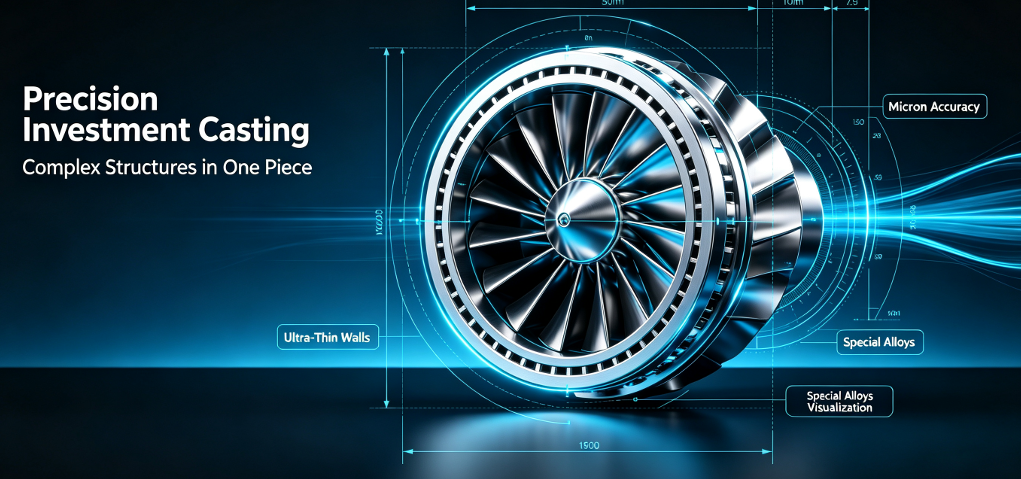
I. Unmatched Freedom in Geometric Design
Investment casting is akin to metal 3D printing, capable of producing intricate structures unachievable by conventional manufacturing processes:
- Ultra-thin wall thickness of 0.5 mm, equivalent to five stacked sheets of A4 paper
- Integral turbine blades with seamless internal air cooling passages, eliminating welding requirements
- Micron-level dimensional precision with surface roughness below Ra3.2 μm
- Undercut geometries enabling streamlined concealed oil channel designs
II. Versatile Compatibility with Diverse Materials
This process works with a wide spectrum of hard-to-process materials, ranging from superalloys to medical-grade titanium:
- High-temperature resistant nickel-based alloy components, stable for continuous service at 1000°C
- Biocompatible alloys ideal for orthopedic implants that integrate seamlessly with human tissue
- Lightweight magnesium-aluminum alloy castings weighing 30% less than counterparts made via traditional casting
- Excellent workability for refractory metals including tungsten and molybdenum
III. Cost-Efficiency Across the Entire Product Lifecycle
Despite a higher unit price upfront, it delivers superior overall economic benefits:
- Over 60% raw material savings compared with subtractive manufacturing
- 80% reduction in post-processing machining operations
- 40% lower average amortized mold costs for small-batch production
- Scrap rate controlled within 3% for highly complex components