High‑Temperature Investment Casting Parts: Material Selection Guide for Harsh Working Conditions
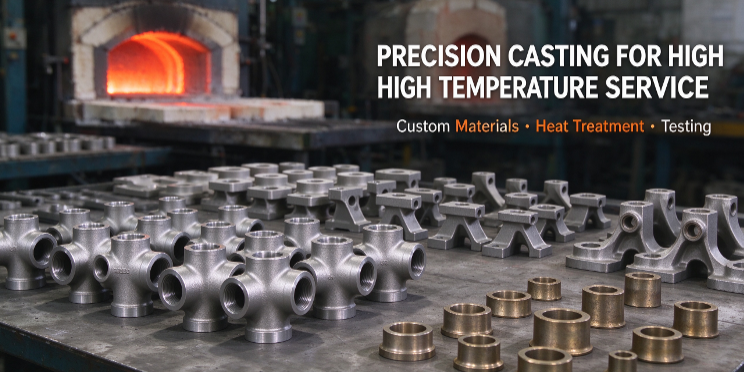
In sectors including construction machinery, heat‑treatment furnaces, petroleum equipment, kilns and thermal‑energy facilities, many components must operate continuously under high‑temperature conditions. Some working environments also combine thermal cycling, oxidation and sulfide corrosion. Ordinary carbon‑steel castings tend to suffer reduced strength, creep deformation and oxidative scaling at high temperatures. In severe cases, cracking failure may occur, threatening overall equipment safety and service life. For these demanding applications, investment (lost‑wax) casting enables the production of complex‑shaped heat‑resistant castings, and proper material selection is critical for reliable component performance.Based on actual operating temperature, load type and corrosive media, suitable materials can be selected for investment castings as follows:
- Continuous operating temperature ≤450℃ Carbon and low‑alloy cast steels such as WCB, GS235 and IC1030 offer cost‑effective performance. These materials feature stable smelting and proven investment‑casting processes, delivering good mechanical properties at room and moderate temperatures. They are widely used for boiler auxiliary supports and general high‑temperature pipe connectors. Note that their high‑temperature oxidation resistance is limited; surface protection treatments are recommended for long‑term high‑temperature service. They are not ideal for frequent thermal‑shock conditions.
- Operating temperature: 450℃‑600℃ Cr‑Mo series low‑alloy heat‑resistant cast steels, represented by 42CrMo, are recommended. Chromium and molybdenum elements greatly improve creep resistance and prevent plastic deformation under sustained high‑temperature loads. After casting, quenching‑and‑tempering heat treatment is applied to refine grain structures and relieve residual casting stress, further enhancing high‑temperature rupture strength. These castings are commonly adopted for high‑temperature equipment joints and load‑bearing brackets.
- Operating temperature: 600℃‑900℃ Heat‑resistant stainless steels are preferred. Grade 304 can withstand short‑term temperatures up to 600℃, while 310S stands out for excellent high‑temperature oxidation resistance and long‑term service up to 900℃, with good resistance to sulfur‑bearing corrosion. It is widely applied in heat‑treatment furnace tooling and internal kiln components. Solution annealing is normally required for these stainless‑steel castings to eliminate casting stress and secure stable metallurgical structures at high temperatures.
- Operating temperature >900℃ Nickel‑base alloy castings are the choice for such extreme conditions. Nickel‑base alloys combine outstanding high‑temperature strength and creep resistance for continuous service at temperatures over 1000℃. Nevertheless, raw‑material costs are high and investment‑casting production is technically challenging, requiring strict control over shell‑making, melting and pouring processes. They are mainly used for high‑value core parts such as gas‑turbine components and critical kiln assemblies.
Apart from temperature, multiple service factors should be considered during material selection. Where water vapour or sulfides exist at high temperatures, higher‑chromium grades are needed to mitigate high‑temperature corrosion. For components subject to alternating hot‑cold cycles, thermal cracking risk rises. Besides material grade optimisation, part structural design and casting procedures also need fine‑tuning.As a professional investment‑casting manufacturer, we adopt silica‑sol lost‑wax casting technology to produce heat‑resistant castings in carbon steel, alloy steel, heat‑resistant stainless steel and nickel‑base alloys. We support custom development from customer drawings or physical samples, and provide one‑stop services covering heat treatment, CNC machining and non‑destructive testing. Material spectrum reports, mechanical‑property certificates and PT penetrant‑inspection documents are available. Our products are exported to many countries across Europe and America, serving customers from construction‑machinery, thermal‑equipment, petroleum and marine industries. Engineers and purchasing teams are welcome to share your working‑condition parameters for customised precision‑casting solutions.