Can Precision Castings Be Customized Only with Drawings? Manufacturer Explains the Customization Process
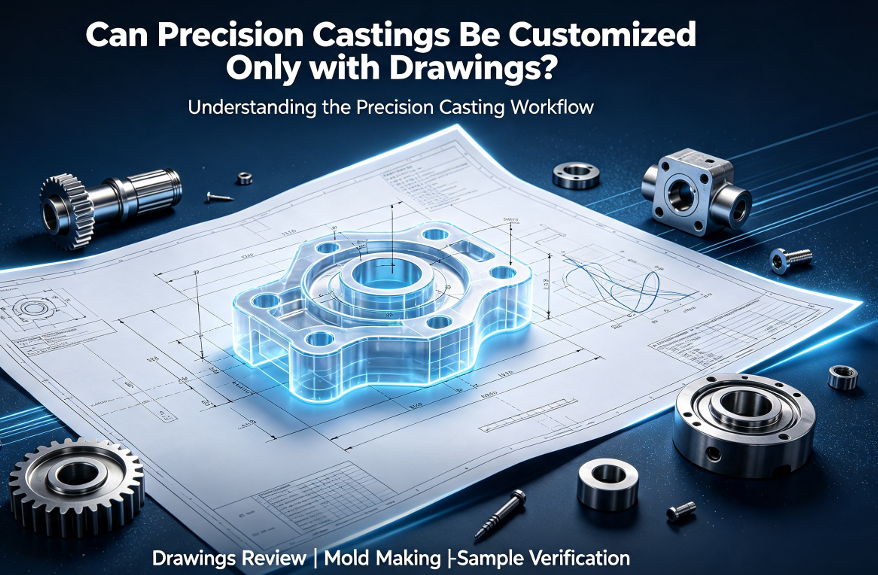
Many purchasers often encounter a problem when developing new products. As the products are still in the research and development phase without physical samples, they only have engineering drawings and wonder whether they can entrust manufacturers to produce precision castings directly. In response to this common industry question, professional precision casting manufacturers give a clear answer: qualified drawings alone are sufficient to launch customized production of precision castings.Drawings serve as the most critical technical basis for customized precision casting, as well as core materials for manufacturers to conduct process review, mold design and wax pattern trial production. During communication, purchasers are advised to provide 3D models in STEP or IGS formats together with 2D CAD engineering drawings for optimal results. The drawings shall clearly mark overall dimensions, key assembly tolerances, wall thickness transitions, fillet requirements and material grades. Meanwhile, technical specifications including heat treatment methods, surface treatment standards and non-destructive testing requirements should be specified.After receiving drawing documents, the technical team will immediately carry out process feasibility review. Engineers will focus on checking component structures to identify designs unfavorable for investment casting, such as abrupt wall thickness changes, sharp corners and narrow closed inner cavities. Optimization suggestions for drawings will be offered at positions prone to defects including shrinkage porosity, cold shut and misrun, so as to reduce casting rejection risks from the source. Once the process review is passed, injection wax molds will be designed and manufactured based on 3D data to produce wax patterns. The whole set of investment casting procedures including tree assembly, shell making, dewaxing, preheating and melting & pouring will be implemented to complete the trial production of first articles.For cases where only 2D drawings are available without 3D models, manufacturers can also build 3D models according to 2D dimensions, though the modeling cycle will be extended appropriately. If the drawings contain missing dimensions, dimensional interferences, conflicting markings or other issues, technical staff will verify information with purchasers timely to avoid trial production errors.Industry technicians also offer practical purchasing advice. In the new product development stage, small-batch sampling trial production is recommended. After the first article is manufactured, dimensional inspection, visual examination and mechanical property tests will be carried out. Mass production can be arranged only after all indicators meet standards. In addition, purchasers may provide information about service conditions and working environments of components. Manufacturers can adjust pouring processes and heat treatment schemes accordingly to guarantee the long-term service stability of precision castings.With accelerated iteration of new products in industries such as machinery and equipment, construction machinery, petroleum equipment and agricultural machinery parts, the model of customizing precision castings based on drawings greatly shortens the R&D cycle of new products. It helps numerous enterprises skip physical mapping procedures and efficiently advance localized customization of components.