Mainstream Processes in the Investment Casting Industry 2026: Silica Sol Investment Casting Dominates High-End Market, Sodium Silicate & Composite Shells Occupy Segmented Sectors
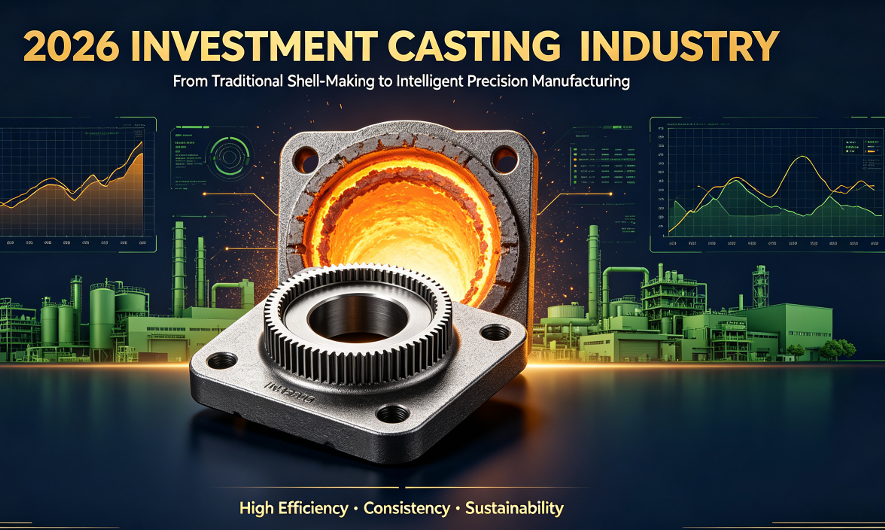
Recently, the China Foundry Association hosted the 60th National Technical Training Seminar on Investment Casting in Beijing, where the 2026 H1 National Investment Casting Process Market Research White Paper was officially released. The document clearly defines three tiered mainstream processes for domestic investment casting: medium-temperature wax silica sol investment casting serves as the core mainstream process for high-end castings; sodium silicate investment casting acts as the general-purpose basic process; silica sol-sodium silicate composite shell casting works as an intermediate transitional solution, forming a differentiated and tiered industrial production landscape.Survey data indicates that silica sol investment casting accounts for over 55% of China’s total investment casting output in 2026, firmly holding the dominant position in the high-end precision casting sector. Sodium silicate casting makes up approximately 40% of output, focusing on mass-produced general low-to-medium-end castings. Composite shell processes represent the remaining 5%, mostly applied to mid-range components requiring balanced cost and performance. Driven by surging orders from new energy, oil & gas equipment, marine engineering, medical devices and aerospace industries, orders for silica sol investment casting have risen 16.8% year-on-year, becoming the core process fueling export growth of the whole industry.
1. Top Mainstream Process of 2026: Silica Sol Investment Casting (Medium-Temperature Wax System)
The white paper identifies silica sol casting as the standard mainstream process for high-end precision casting in the current industry. It uses colloidal silica as the shell binder paired with medium-temperature wax assembly for pattern forming, uniquely suited for manufacturing high-precision, smooth-surface, thin-walled complex special-shaped castings.Core technical parameters of the process: cast surface roughness reaches Ra1.6~3.2μm, dimensional tolerance stably maintained at CT4~CT6 grades. Defect rates such as thin-wall deformation, sand inclusion and blowholes drop by over 60% compared with traditional processes. It is compatible with a wide range of premium materials including 304/316L stainless steel, 42CrMo alloy steel, superalloys and duplex stainless steel, fully meeting international quality certification requirements for European and American export orders such as EN10204-3.1, PED pressure equipment certification and IATF16949.Downstream applications cover high-value products including oil & gas cable protectors, hydraulic precision brackets for forklifts, new energy motor housings, marine valve bodies, medical implant components and aerospace structural parts. It is also the preferred technical transformation route for leading export-oriented domestic foundries. With the widespread adoption of automated robotic shell-making lines and constant temperature & humidity intelligent drying systems, the historical drawbacks of long production cycles and high costs for silica sol processes are continuously mitigated, lowering comprehensive production costs for large-scale manufacturers year by year.
2. General Basic Mainstream Process: Sodium Silicate Investment Casting
Sodium silicate casting remains a widely adopted basic mainstream process among small and medium foundries, featuring low raw material costs, fast shell carbonation hardening and low equipment investment for mass general castings. Using sodium silicate as the binder with CO₂ rapid shell hardening, its single-piece production cost is 20%-30% lower than silica sol casting, alongside shorter lead times.However, inherent process limitations restrict surface roughness to Ra6.3~12.5μm and dimensional tolerance to CT8~CT9, failing to satisfy precision standards for high-end components. It is mainly used for ordinary carbon steel construction machinery parts, general valves and agricultural machinery castings, targeting domestic low-cost bulk buyers. Stricter environmental regulations and EU CBAM carbon border adjustment mechanisms accelerate the phase-out of small workshops relying purely on sodium silicate, with its market share continuously squeezed by silica sol casting.
3. Transitional Mainstream Process: Silica Sol-Sodium Silicate Composite Shell Casting
Composite shell casting combines the merits of both processes: the face layer adopts silica sol to guarantee surface precision, while the backup shell uses sodium silicate to cut production costs, acting as a cost-effective compromise solution for mid-range products. It caters to construction machinery and general hydraulic components with moderate precision requirements and tight budget limits. While market demand remains stable, it faces dual competitive pressure from the other two core processes with limited growth potential. Industry experts predict it will only exist as a supplementary process in the long run.