Burn‑on Defect in Investment Casting: Causes & Complete Solutions
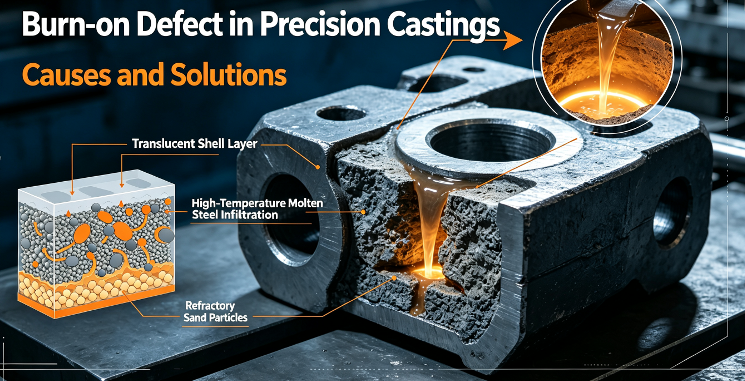
Burn‑on (sand adhesion) is one of the most common surface defects for investment‑cast steel components widely used in construction machinery, petroleum equipment, forklift and agricultural machinery parts. Fused refractory sand sticks firmly to casting surfaces, greatly increasing shot‑blasting and grinding workload. Severe burn‑on will lead to scrap parts and affect production yield & delivery schedule. Burn‑on falls into two categories: mechanical burn‑on and chemical burn‑on, with different formation mechanisms and improvement methods.
Main Causes of Burn‑on Defect
- Refractory material & face‑coat issuesLow refractoriness of face‑coat powder cannot resist thermal shock from molten steel. Improper powder grain‑size proportion creates large pores inside ceramic shell, enabling molten metal to penetrate into shell gaps, forming mechanical burn‑on. For carbon steel casting, iron oxide generated at high temperature will chemically react with silica from shell and form low‑melting silicate phases, bonding sand grains onto casting surface, known as chemical burn‑on which is much harder to clean. Insufficient coating thickness or missing coating areas on wax pattern also trigger this defect.
- Poor shell‑making and shell‑firing processInadequate drying time & humidity control leaves moisture and residues inside shell. Low firing temperature or insufficient holding time prevents full shell sintering, resulting in poor high‑temperature strength and density. Deep holes, narrow slots and sharp corners are high‑risk zones where uniform coating is hard to achieve.
- Unreasonable pouring parametersExcessively high pouring temperature improves fluidity of molten steel and encourages metal penetration. Too fast pouring velocity washes and damages shell face‑coat. Heavy‑wall sections keep high temperature for long time and aggravate burn‑on risk.
- Influence of casting geometryDeep cavities, narrow gaps and sharp corners slow heat dissipation. The shell in these areas stays hot far longer after pouring, significantly raising burn‑on possibility.
Practical Countermeasures Against Burn‑on
- Upgrade refractory material and slurry formulaAdopt high‑refractoriness face‑coat powder, optimize grain‑size distribution to get dense shell surface and narrow inner pores. For carbon & alloy steel castings, select chemically inert refractory aggregate to restrain chemical reaction between molten metal and shell. Control slurry viscosity and guarantee full & even coating thickness without missing spots.
- Standardize shell building & firing procedureFollow strict drying parameters including temperature, humidity and duration for each shell layer. Set proper firing temperature and holding time to remove residual wax, moisture and organics completely, improving shell high‑temperature performance. Apply extra local coating reinforcement for deep holes, grooves and sharp corners.
- Adjust pouring process parametersLower pouring temperature within acceptable filling range. Slow down pouring speed to avoid violent erosion towards shell inner wall. Optimize gating‑riser system to reduce local overheating on heavy‑wall sections.
- Casting geometry optimizationIncrease fillet radius for sharp corners and eliminate narrow gaps if drawing allows. If product geometry cannot be modified, adopt extra‑coating or local chilling as compensation measures.
- Post‑treatment noteLight burn‑on can be removed by shot blasting and grinding. Heavy burn‑on causes dimension out‑of‑tolerance and substrate damage, and such castings have to be scrapped. Burn‑on prevention focuses on upstream process control rather than post‑repair.