Can 42CrMo investment castings undergo quenching and tempering heat treatment?
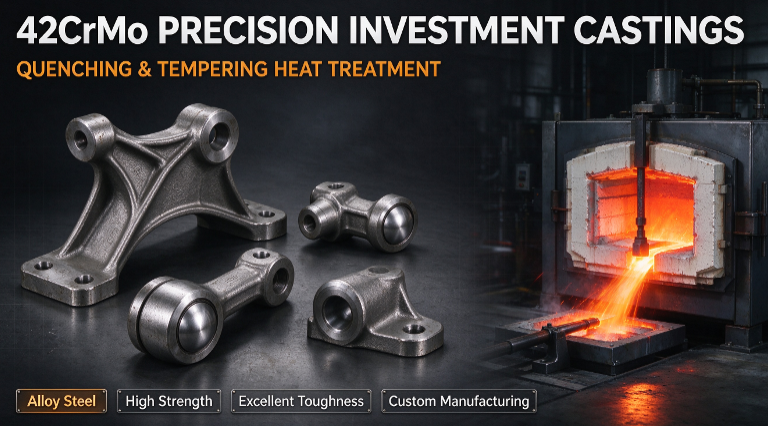
42CrMo investment castings are fully eligible for quenching and tempering heat treatment, which is also the most common strengthening process for castings of this material. Quenching and tempering refers to the complete process of quenching plus high‑temperature tempering. As a chromium‑molybdenum medium‑carbon alloy steel, 42CrMo features excellent hardenability. The molybdenum element can effectively temper brittleness, making it highly suitable for strengthening investment castings via quenching‑tempering. It is widely applied to load‑bearing castings subjected to alternating and impact loads in construction machinery, forklifts, agricultural machinery and petroleum equipment, such as connectors, brackets, ball‑joint housings and suspension supports.Before quenching and tempering, investment casting blanks generally receive pre‑treatment. Normalizing is adopted to refine casting grains, relieve casting stress and chemical segregation generated during pouring and cooling, and mitigate internal porosity and inhomogeneous microstructure, laying a solid foundation for subsequent quenching‑tempering. In the standard quenching‑tempering procedure, castings are heated to 840‑860 °C and held for full austenitization. Oil quenching is applied to lower the risk of cracking and deformation for complex castings, followed by high‑temperature tempering within 500‑620 °C. The tempering temperature can be adjusted according to customer drawing requirements to achieve target hardness. The conventional hardness range after quenching‑tempering is 28‑36 HRC, and customized hardness is available. After heat treatment, the microstructure transforms into tempered sorbite. The castings acquire high tensile strength, favorable toughness and fatigue resistance, greatly extending service life under repeated‑impact working conditions and preventing force‑induced fracture.Heat‑treatment‑caused deformation is strictly controlled. Process protection is implemented in advance for sharp corners and sections with large thickness differences. Hardness testing and metallographic sampling inspection are available after quenching‑tempering. MT magnetic particle testing and PT penetrant testing can be performed on demand to detect heat‑treatment‑induced cracks. Complete heat‑treatment reports and material certificates are provided. Where further machining is required, quenching‑tempering is arranged after rough machining and before finish machining to release most heat‑treatment stress and reduce deformation in subsequent finishing. For special technical requirements such as higher hardness or specified mechanical properties, we can evaluate whether additional processes like surface induction hardening can be applied on the basis of quenching‑tempering. Heat treatment for export orders can comply with overseas standards. Submit your drawings for process feasibility assessment and cost quotation.