Material Selection for Corrosion-Resistant Investment Castings
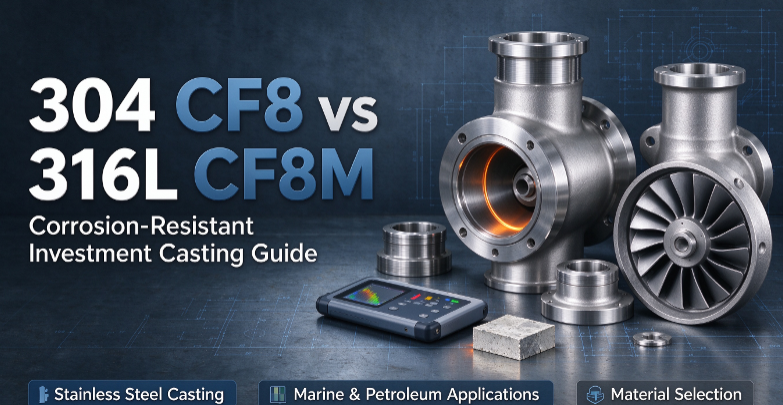
In investment casting projects, material selection for corrosion-resistant components is one of the most frequently asked technical topics from overseas buyers. Many equipment designers and purchasers often struggle to decide between 304 stainless steel castings (casting grade CF8) and 316L stainless steel castings (casting grade CF8M) for anti-corrosion applications. Both austenitic stainless steel castings rely on chromium to form a passive surface film for corrosion protection. However, differences in alloy composition lead to distinct working conditions, service life and procurement costs.304 (CF8) investment castings mainly consist of chromium and nickel. It delivers reliable corrosion resistance under normal atmospheric conditions, fresh water and weak organic acids at room temperature. The passive film remains stable for indoor dry environments, rainwater and general food processing equipment. This material features lower melting difficulty, high yield rate in investment casting and competitive raw material cost, making it suitable for structural parts in chloride-free environments.The obvious disadvantage of 304 is the absence of molybdenum, resulting in poor resistance to chloride corrosion. In coastal salt spray, seawater, brine and chlorine-containing disinfectant media, chloride ions can easily break down the passive film. Pitting corrosion and crevice corrosion tend to occur at tiny pits and gaps on the casting surface. In severe cases, perforation and leakage may happen, causing equipment failure.316L (CF8M) investment castings add molybdenum based on chromium and nickel, with a low-carbon formula. Molybdenum greatly improves resistance to chloride pitting and crevice corrosion. The low-carbon design reduces the risk of intergranular corrosion after welding or high-temperature processing. For seawater, heavy coastal salt spray and chlorine-containing chemical fluids, 316L castings outperform 304 castings in corrosion resistance. They are widely adopted for marine fittings, offshore equipment, offshore petroleum machinery, chemical pump and valve investment castings.Nevertheless, 316L has limitations. It comes with higher raw material prices. During investment casting, molten steel is more prone to oxidation and inclusions, requiring strict production control and leading to higher casting costs. 316L is not fully corrosion-proof either. Corrosion may still occur under high-concentration chloride or high-temperature strong acid environments, where higher-grade special alloys should be considered.
Summary of Investment Casting Material Selection
✅ Choose 304 CF8: Dry indoor environments, fresh water, normal atmosphere, no chloride ions, cost-sensitive projects. ✅ Choose 316L CF8M: Coastal salt spray, seawater, chloride-containing media, components with high requirements for pressure resistance and leakage prevention.
Important reminder: Wrought grades 304/316L cannot be directly equated to casting grades CF8/CF8M due to different chemical composition ranges. When drawings specify material requirements, investment castings must be produced according to casting grades. Surface defects, internal porosity and shrinkage cavities on castings will act as corrosion starting points. Strict casting process control and spectrum inspection are required during production, with COA material certificates available for each batch.
If you are unsure which stainless steel grade fits your working conditions, please provide medium type, operating temperature and chloride content. Our investment casting team can support material evaluation and sample trial production.