Precision Casting Industry Achieves Multi-Dimensional Breakthroughs: Intelligent and Green Transformation Reshapes Industrial Pattern
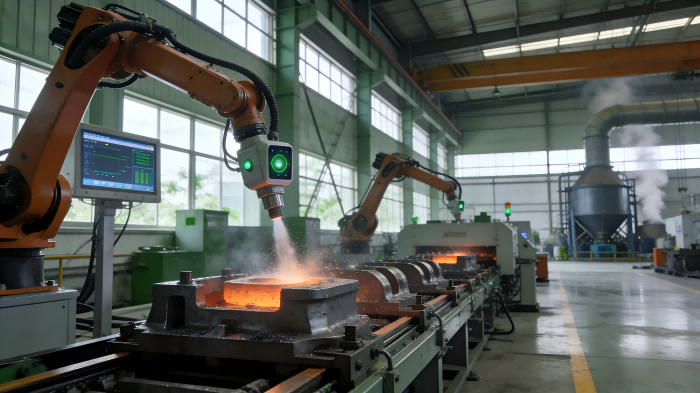
News Report (Reporter Doubao) Recently, China's precision casting industry has witnessed multiple technological and production capacity breakthroughs. From the commissioning of automated production lines to the launch of unmanned factories, and from process innovation to model innovation, the industry is accelerating its transformation from traditional manufacturing to digital and green manufacturing, laying a solid foundation for the independent controllability of core components in the high-end equipment manufacturing industry.In Hunan Province, the automated production line for precision turbine housing casting of Hunan Tianyan has recently completed full-process commissioning and started small-batch trial production, marking a key milestone for the enterprise's capacity expansion and technological upgrading. It is understood that the production line, built in line with top industry standards, features a full-process intelligent system integrating core equipment such as high-efficiency wax injection machines, fully automatic shell-making lines, and intelligent casting units. It forms an integrated production closed loop from wax pattern production to finished product cleaning, with an annual capacity of 300,000 pieces, focusing on high-value-added and high-precision products such as supercharger turbine housings and small valve parts. The commissioning of this production line not only realizes large-scale mass production of high-precision products but also adds independent production capacity for supercharger turbine housings, breaking external supply dependence and building a fully closed-loop supply chain with independent controllability of core components.Huangshi City in Hubei Province has launched the province's first unmanned factory in the casting field. The "250,000-ton Precision Materials Unmanned Manufacturing and Processing Project" of Huangshi Dongbei Casting Co., Ltd. has passed provincial-level review and been awarded the title of "Hubei Provincial Unmanned Factory Demonstration Unit". The project introduces internationally advanced automated production lines and digital twin platforms, realizing unmanned operation throughout the entire process from raw material processing, smelting and casting to precision machining. The equipment automation rate exceeds 95%, and production efficiency is 30% higher than that of traditional models. At the same time, it integrates technologies such as waste heat recovery and water resource recycling, reducing unit product energy consumption by 20% and annual carbon emissions by 12,000 tons, creating an industry model for the coordinated development of "unmanned + green" manufacturing. Currently, it has driven 3 upstream and downstream enterprises to settle in the park, increasing the overall efficiency of the industrial chain by 25%.In terms of process innovation, the industrial application of Hydrostatic Forging Casting (HFC) technology has made breakthrough progress. Dongfeng Motor's General Casting and Forging Branch has successfully achieved stable mass production of the cam bearing seat assembly for Dongfeng Commercial Vehicle's DDi13 engine and the 4HD70 electric drive intermediate plate for Zhixin Technology using this technology. It is reported that HFC technology effectively solves defects such as porosity and shrinkage in traditional processes through core mechanisms including nitrogen-protected pouring and dynamic hydraulic extrusion feeding, increasing the density of aluminum alloy castings by more than 30% and significantly optimizing tensile strength and fatigue life, which can meet the strict requirements of core components under complex loads. At present, the enterprise has established HFC mold parameter design specifications, laying a foundation for expanding the application scope of lightweight non-ferrous products.Digital transformation has also become a key path to solving the industry's cost and efficiency bottlenecks. Huizhou Jibang Precision has launched a pre-research-led joint development model, forming a cross-field team with vehicle manufacturers and universities in the product conceptual design stage, and optimizing product structure and process plans in advance through DFM (Design for Manufacturing) analysis. Relying on technologies such as CAD/CAE simulation and 3D printing, the enterprise has shortened the wax pattern production cycle from several months to 1-3 days, increased the qualified product rate by more than 40%, reduced the comprehensive manufacturing cost by 20% in the automotive EGR component project, and controlled the scrap rate at an extremely low level of 1%-3%, providing a replicable model for the industry's digital transformation.Industry insiders stated that the current market size of China's investment casting industry has exceeded 25 billion yuan, with a compound annual growth rate of over 7.5%. With the popularization of intelligent equipment, iterative process innovation, and green production upgrading, the precision casting industry is breaking away from the traditional "experience-driven" model and moving towards a high-quality development stage of "data-driven and process-controllable". In the future, as technological costs continue to optimize, these innovative achievements will further penetrate into high-end fields such as aerospace, medical devices, and rail transit, helping to enhance the safety, stability, and global competitiveness of China's manufacturing industry chain and supply chain.